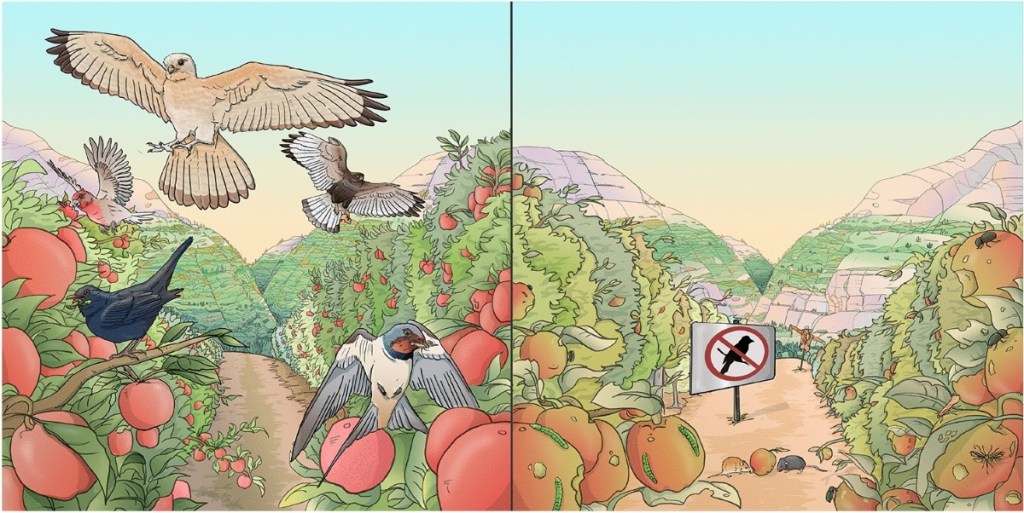
“An insect pest is any insect in the wrong place—from a human point of view; just as a rose bush is a weed when it is growing in a cabbage patch.”
C.B. Williams (1947)
Insects are at the base of a complex ecological food web and are critical for healthy ecosystems. Less than 0.5% of insect species eat our crops. As a result, we want to support a diverse insect population at Lakeside while at the same time managing pest insects.
Birds for insect pest control
While many gardeners understand the importance of attracting predatory insects and parasitoids to control pest insects, only recently has the role of birds as biological control agents being recognized thanks to the work of organizations like Wild Farm Alliance.
Stefan Sobkowiak recommends three strategies for recruiting birds to help with insect pest control in his permaculture orchard. In 2025, we’ll experiment with the first two strategies by installing bird boxes for aerial insectivores and songbirds.
- Strategy 1: Attract aerial insectivores such as Flycatchers, Swallows, Eastern Bluebirds and Purple Martins. Aerial insectivores capture adult moths and butterflies, preventing them from laying eggs.
- Strategy 2: Attract songbirds, such as Eastern Bluebirds, Sparrows, House Wrens, Robins and Orioles. They need thousands of high protein caterpillars and other insects to feed their young.
- Strategy 3: Support overwintering birds such as White-Breasted Nuthatches, Chickadees and Woodpeckers. They feed on caterpillar cocoons and egg masses. He uses bird feeders to encourage these birds to hunt in different areas of his permaculture orchard throughout the winter.
Crop pests that birds eat
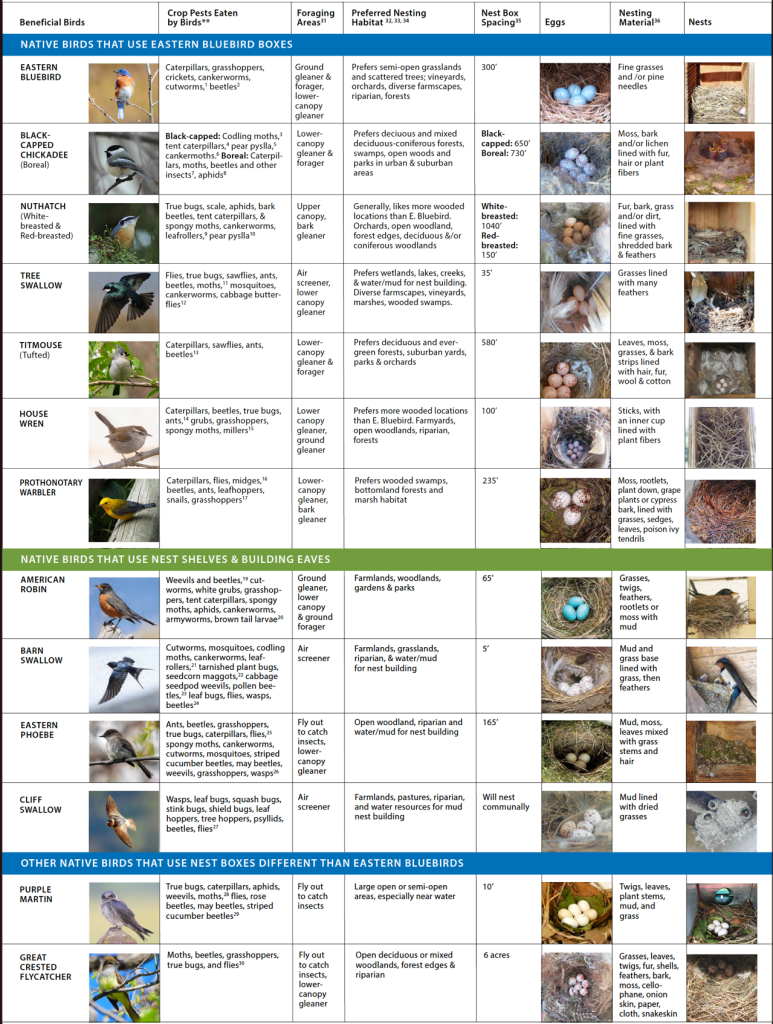
This chart by Wild Farm Alliance summarizes the different pest insects consumed by the birds we hope to attract. Studies have found that birds can, for example, consume between 13% and 99% of overwintering Codling Moths and reduce overwintering pest insects by between 55% and 90%. Missing from the chart is Downy Woodpecker. They consume Corn Earworms, Tent Caterpillars, Bark Beetles, Codling Moths and Apple Borers.
Creating diverse habitats for birds
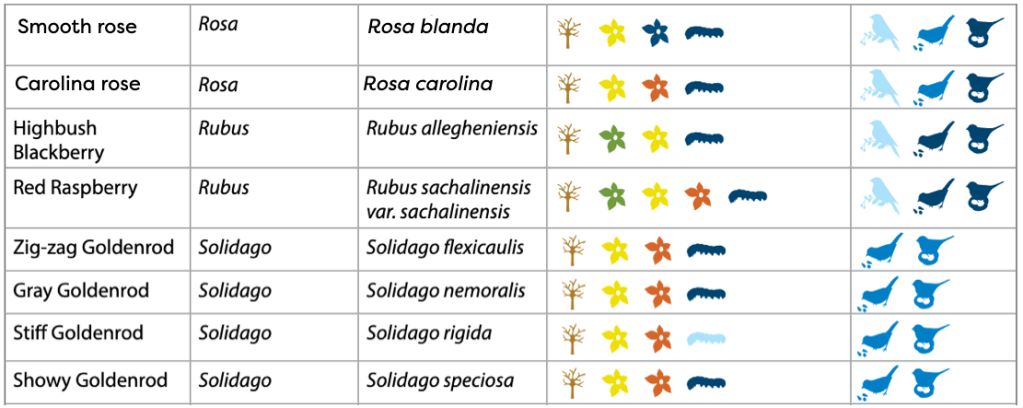
When feeding their young, the average parent bird visits their nest over 150 times a day, or every five minutes. Thanks to our butterfly garden, beetle banks, pocket meadows, hedgerows, medicinal garden and little forest, we already have the diverse habitats, cover and food sources needed to attract a wide range of birds. In our little forest we have keystone tree species like Oak, American Plum, Black Cherry, Chokecherry, Apple and Maple. In our hedgerows, food forest and meadow plantings we have keystone native perennials like Goldenrod, Aster, Helianthus and Rudbeckia as well as a diversity of fruiting shrubs.
As a result, we’ve seen a large increase in Goldfinches, Robins and various species of Sparrows. In 2024, a pair of Mourning Doves took up residence and we spotted our first Northern Flicker.
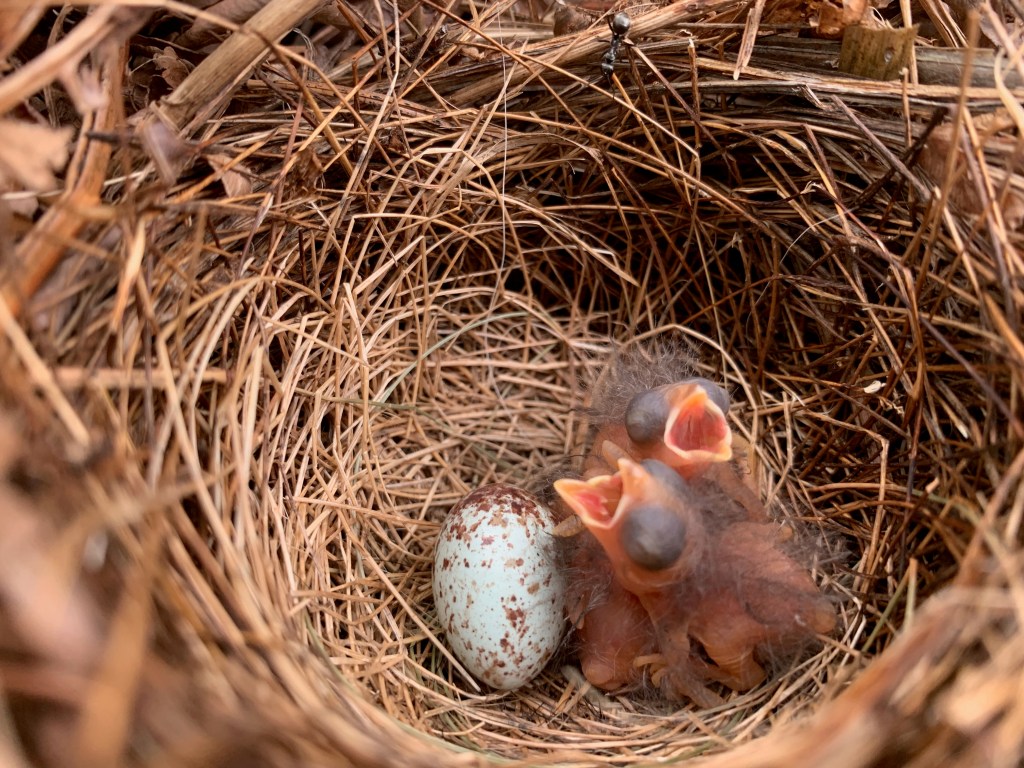
While we now have safe places for birds to nest on the ground and in thickets, what we’re missing are snags (dead, standing trees) for cavity nesters. As a result, in 2025 we’ll be installing nest boxes.
Nest boxes for cavity nesting birds
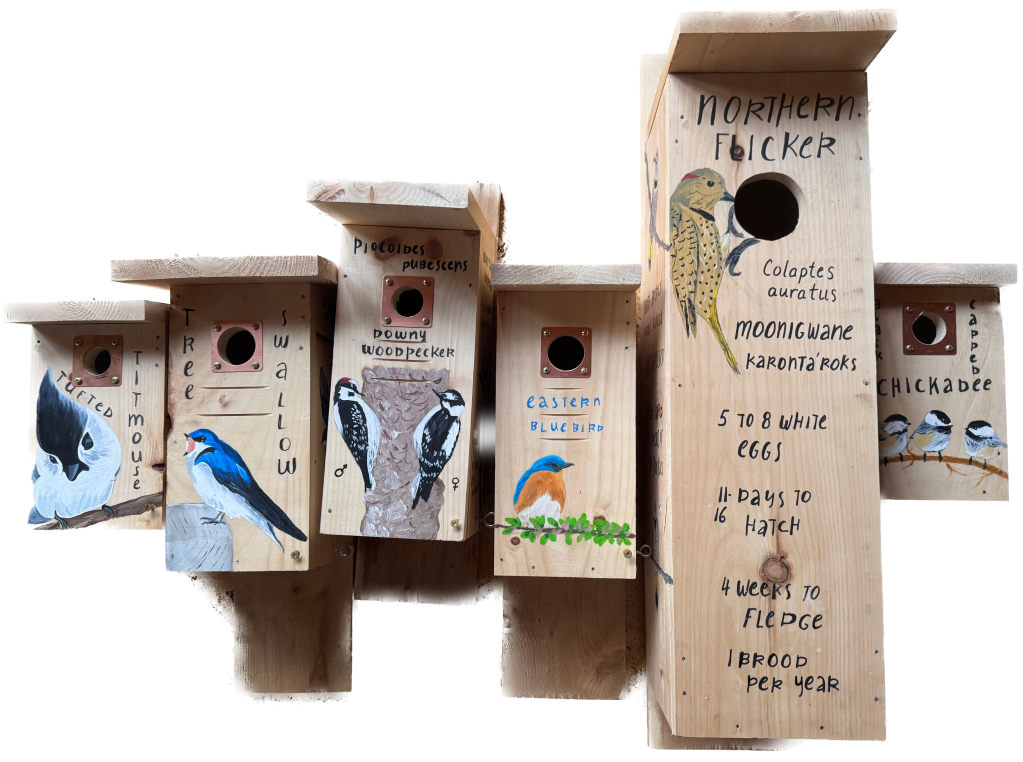
Here are the birds for whom we’re installing nest boxes and how we’ll determine where to locate the boxes:
- Bluebirds: Open area. Height 1.2-1.8m. East facing. Spacing 91m.
- Tree Swallows: Open area. Height 1.5-1.8m. East or south facing. Spacing 10m.
- Chickadees: Edge of little forest or in food forest. Optional 2.5cm of wood shavings. Height 1.5-4.5m. Facing away from prevailing South West wind. Spacing 198m.
- Nuthatches: Edge of little forest or in food forest. Optional 2.5cm of wood shavings. Height 1.5-4.5m. South facing. Spacing 204m.
- Great Crested Flycatcher: Food Forest. Prefers hanging nest box. Height 1-6m. Facing any direction. Spacing 1 box per 6 acres.
- Northern Flicker: Along fencerow with open flyway. Fill box with wood chips or shavings. South or east facing. Height 1.8-3.6 m. Spacing 100m.
- Tufted Titmouse: Edge of little forest. Height 1.5-4.5m. Hole facing away from prevailing South West wind.
- Downy Woodpecker: Edge of little forest or in food forest. Height 1.5-4.5m. Face the entrance hole away from prevailing winds. Fill box with wood chips or shavings. Hole facing away from prevailing South West wind.
Installing nest boxes
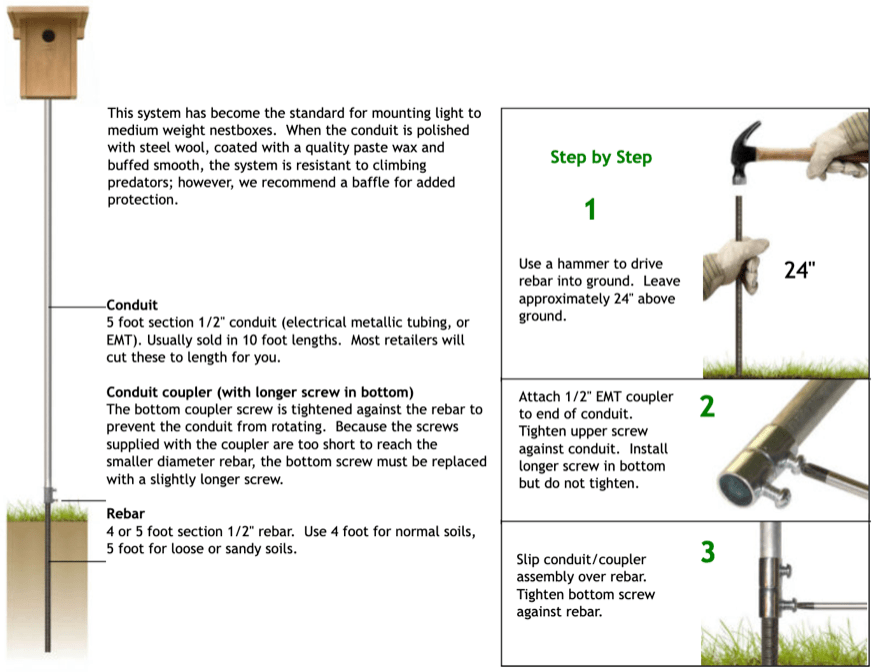
We’ll install nest boxes using two methods. Both of these methods make it easy to mount and clean the nest boxes and ensure the nests are safe from predators.
- Conduit/rebar mounted: Attach nest box to conduit pipe. Pound rebar halfway into the ground. Attach conduit mounted nest box protected with a stovepipe predator baffle.
- Hanging: Use a pole to hang a nest box from a tree.
Birds of Lakeside
Over the next couple of years, we’ll add profiles of birds who nest at Lakeside.
- Killdeer: a ground nesting shorebird
References
- Nesting structures for beneficial songbirds, Wild Farm Alliance
- Beneficial bird native plant chart, Wild Farm Alliance. Contains about 160 native Midwest species (many of these are also native in the Kingston area) that provide various benefits for birds. Includes seasonal floral resources and other plant foods birds consume, plants that support the most caterpillars birds eat, and bird species use of plant genera.
- Supporting beneficial birds and managing pest birds, Wild Farm Alliance
- Role of birds on the farm, online course, Wild Farm Alliance
- Bird‑mediated effects of pest control services on crop productivity: a global synthesis, Díaz‑Siefer et al.
 Lakeside Community Garden