Do you want to grow branches or do you want to grow fruit. Each tree has a limited amount of energy and will put it into branch growth or fruit growth or both. Focus the trees energy in its youth to grow branches and once mature to grow fruit.
— Stefan Sobkowiak, The Permaculture Orchard
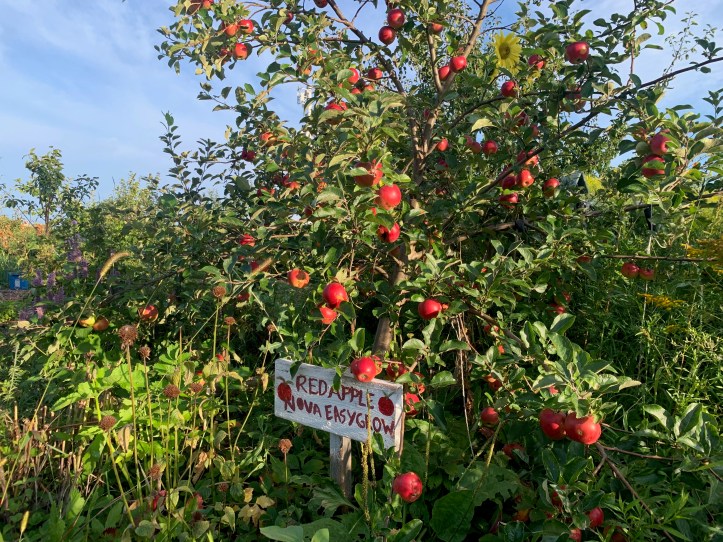
Trees have a limited amount of energy, which they allocate either to vegetative growth or fruiting. When they’re young, to become healthy and sturdy they need to grow vegetatively (their branches and roots). Since pruning delays fruiting, avoid pruning for the first three years. Once the tree is established, depending on your goals, begin training or pruning.
Understand a tree’s architecture
Our role is educators, in favor of each variety’s characteristics… We must let the trees do their own work, and guide them along as best we can.
— Dr. Jean-Marie Lespinasse
Jean-Marie Lespinasse, based at the French National Institute for Agricultural Research (INRA) spent 40 years exploring the question “Should fruit trees be pruned?” He discovered that each cultivar has their own natural behaviours, habits and shapes. If left mostly alone, they’ll develop harmoniously. So instead of pruning to achieve a specific artificial shape, Lespinasse suggests getting to know your trees, how they prefer to grow and working with their natural growth and fruiting habit.
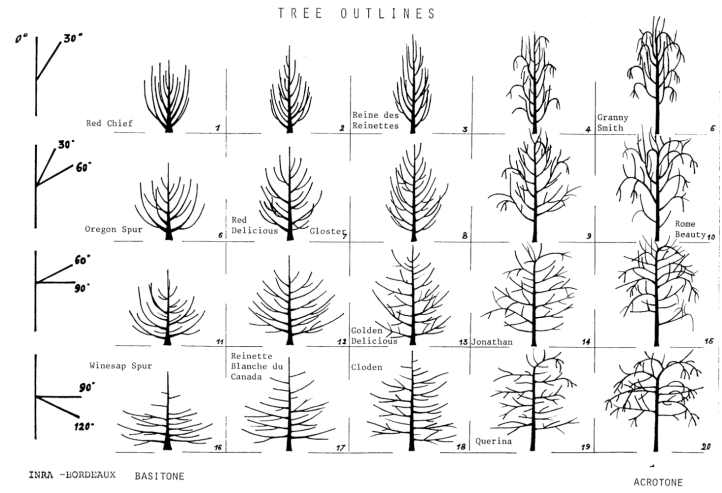
classification using basitony-acrotony gradient & branch angle (Lespinasse & Delort)
Cultivars whose shape resembles the illustrations on the left are basitonic which means the lower branches are stronger, outgrowing those closer to the top of the tree. Their branches also tend to grow upright, with stronger branch angles. And they’re more likely to bear bi-annually. Cultivars whose shape resembles the illustrations on the right are acrotonic, meaning they grow more strongly at the top of the tree. Their branches tend to grow downwards. And they’re more likely to bear annually.
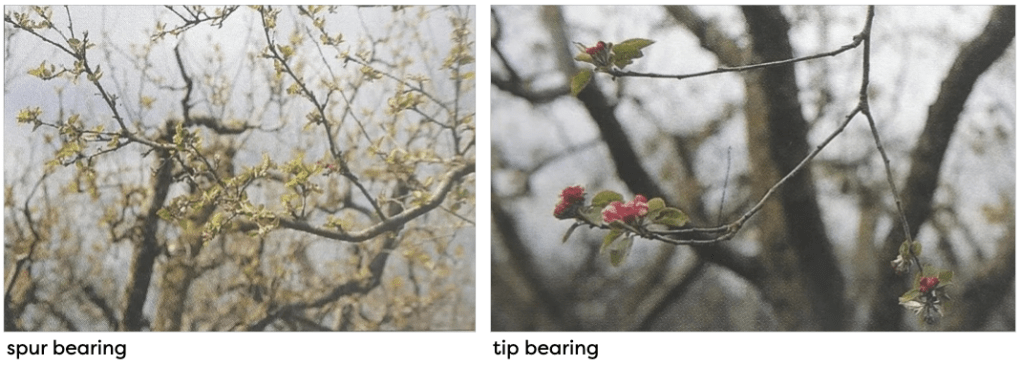
Cultivars to the left also tend to be spur-bearing, while those on the right tend to be tip-bearing. However, even though some cultivars are tip bearing they may bear bi-annually. Others, while spur bearing, may bear more regularly when grafted onto vigorous rootstocks. Home Orchard Society has a list of spur, semi-spur, tip and partial-tip bearing apple varieties.
How to prune using centrifugal training
Do you want a tree or do you want fruit? Stefan Sobkowiak, an excellent educator who shares a wealth of educational content on his YouTube channel, follows the research done at INRA on tree growth, training and pruning. Based on this research, he’s adopted the centrifugal training system which minimizes the need for pruning and respects the natural architecture of the tree. Centrifugal training involves three steps: clearing the chimney of branches, selecting 12-15 scaffold branches and polishing the chimney and undersides of branches to remove small branches and spurs.
Clear the chimney of branches

Think of the chimney as a tunnel surrounding the trunk which acts as conduit for light and air, reducing risk of disease and increasing fruit size. Clearing the chimney also stimulates new branches where needed. Spread out the fingers on your hand, then use your hand to check for anything that’s not one of the scaffold branches (a branch that grows at least 30 cm in its first year). Use your hand to pull off small branches and spurs within 15 cm of the trunk. As the tree grows, progressively enlarge the chimney up to one third of canopy diameter if the tree has a dense canopy.
Select 12-15 scaffold branches
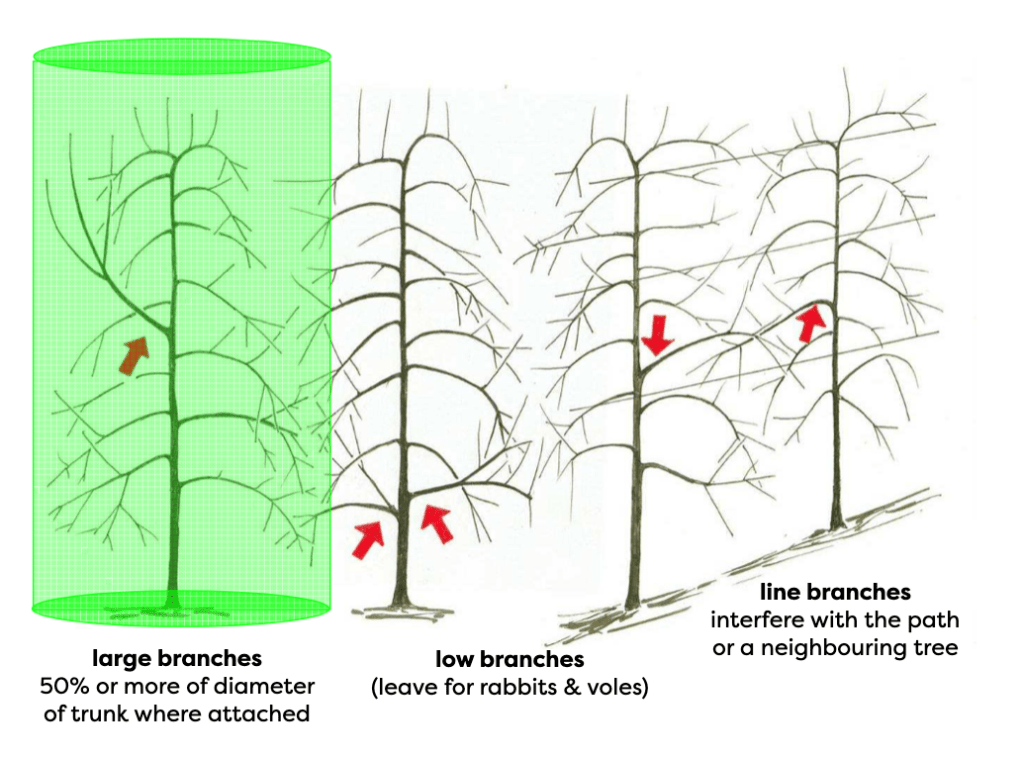
Most trees on smaller rootstocks produce around 24 branches, but to prevent overcrowding, strengthen the upper portion of the trunk and to ensure good fruit production, thin to 12-15 main scaffold branches of similar vigour from bottom to top and with good distribution around the trunk.
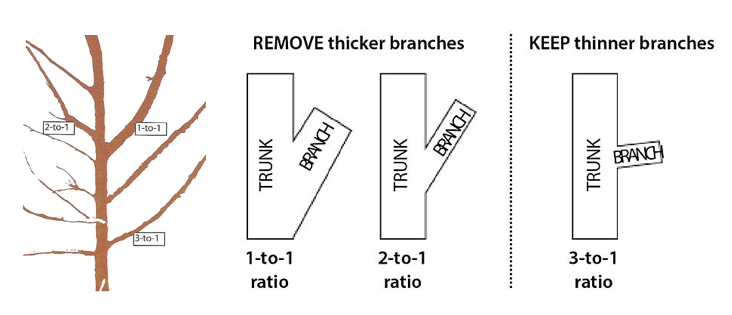
When selecting which scaffold branches to prune out, use the following criteria:
- Large branches that compete with the trunk (branches 50% or more of trunk diameter) or branches with the strongest branch angle. Avoid removing more than two in a year. Remove the ones highest up in the tree first as they grow too vigorously, shading lower branches and reducing fruiting.
- Line branches: branches that grow into the next tree or into the path.
- Low branches below 1.2 metres to help strengthen the upper part of the trunk and help increase the growth of higher branches. Or alternatively, leave low branches for the voles and rabbits to eat in winter.
Keep all side-branches that don’t compete with the scaffold branch. Crack (rather than prune) only the most vigorous suckers that develop near the trunk.
Polish the chimney and undersides of branches

Clear the underside of the remaining branches of young branches and fruiting spurs. This increases light penetration, increases fruit quality and helps control crop load (reducing or eliminating the need to thin).

Run your hand under each branch and if you hook onto something, then remove it with your glove. You only need to do this every 5 years.
Salsa system for Type IV varieties
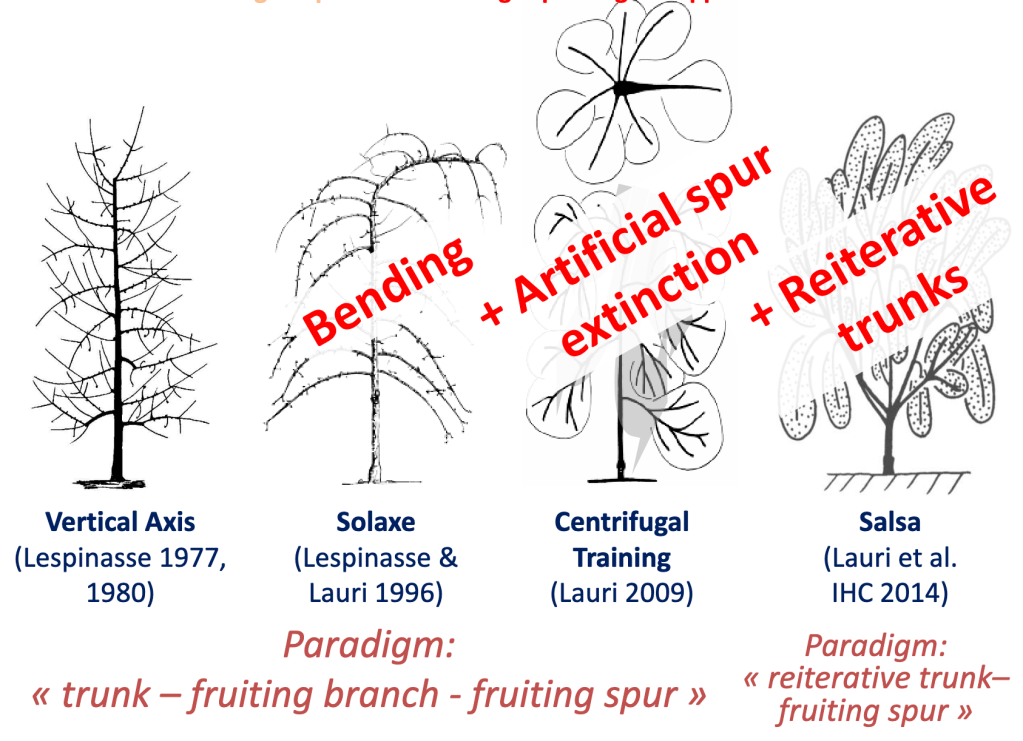
Some cultivars (to the far right of the cultivar diagram) naturally tend towards 2-5 trunks, depending on vigour of individual cultivars and their rootstock. Fruiting shoots are usually distributed within the tree canopy and attached along the reiterative trunks. If branches are too crowded or shaded, you can thin older branches.
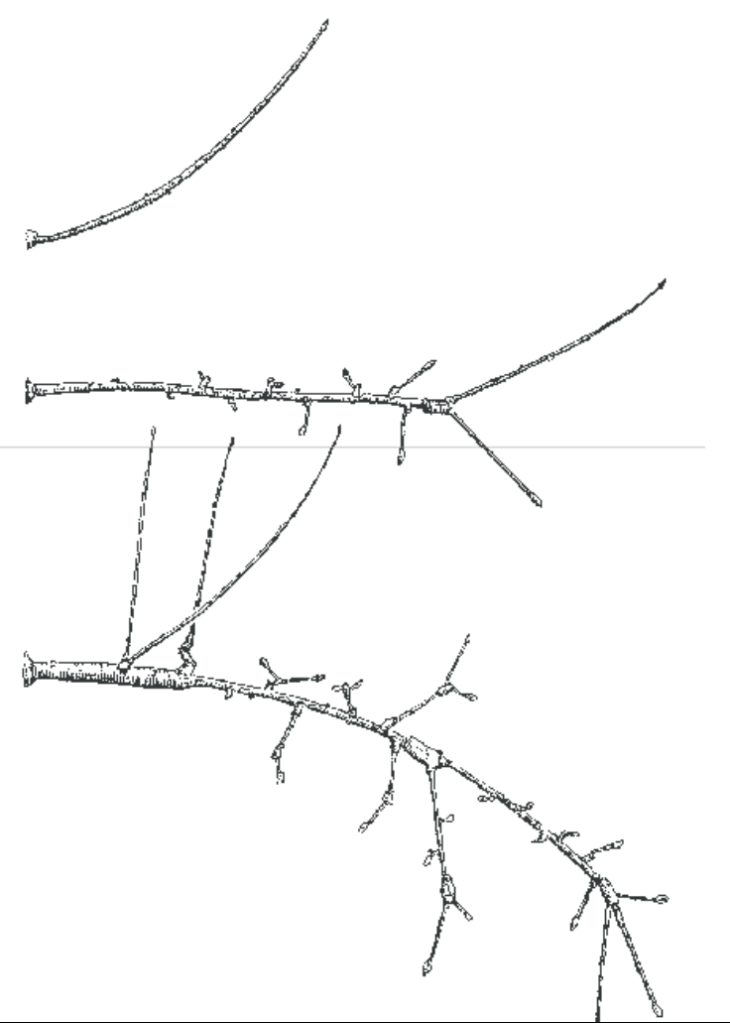
For these cultivars, you won’t need to bend branches, especially if the tree has more than two trunks, as they tend to naturally bend below horizontal beginning in their third year due to the weight of the fruit. If they don’t, they’ll set less fruit. But this also reduces the need for thinning.
How NOT to prune
“Don’t mess with the tree and it’ll give you more fruit sooner and a smaller tree.”
— Stefan Sobkowiak
Here are a few of Stefan Sobkowiak’s most important tips for how NOT to prune:

- Don’t do heading cuts. Respect the natural growth and shape of trees by using thinning cuts only.
- Fruit naturally bends branches. If this doesn’t happen, then train the branch.
- Don’t prune suckers. Pruning suckers causes more suckers. Instead, crack them (bend them till they crack below horizontal) during the dormant season.
- Don’t cut inward facing branches. The more you cut, the more you create. Instead, train them.
- Don’t cut the central leader, let trees grow to their natural shape (though unfortunately, most of the trees are sold with their central leader already cut).
When to prune
Late winter, early spring

Do the bulk of your pruning when trees are dormant, once the chance of very cold temperature swings have passed and before buds begin to swell. To avoid winter injury, the safest time to prune is during eco-dormancy, just before buds swell. During eco-dormancy, buds are still tolerant of freezing and have recovered their capacity to grow, but are waiting for suitable conditions to resume growth.
Summer, late July or early August
If you want to slow a tree down — reducing its vigour (vegetative growth) — prune once trees are fully leafed out and the terminal bud has been set. To prevent spreading fire blight, prune only if the leaves are dry and there’s no rain forecast for at least two days.
References
- Shaping success: the power of Apple tree pruning, Erika DeBrouwerm OMAFRA
- An investigation on timely pruning, cold hardiness and winter injury, Erika DeBrouwerm OMAFRA
- Good to know: ten pruning rules, Bas van den Ende, Good Fruit Grower
- Growing fruit trees, Jean Marie Lespinasse and Evelyne Leterme
- Apple tree architecture and cultivation: a tree in a system, Pierre-Éric Lauri, INRAE
- Concepts in fruit tree training and pruning, is there old versus new paradigms? Viewpoint of a biologist?, Pierre-Éric Lauri, INRAE
- Precision pruning and thinning in Washington, Stefano Musacchi and Tory Schmidt
- Apple and pear tree architecture, a way to improve orchard management, PÉ Lauri
- Get the fruit of your dreams with these 15 types of pruning, Stefan Sobkowiak
- Training and pruning apple trees, Cornell Cooperation Extension
- Developing a new paradigm for apple training, Pierre-Eric Lauri (2009)
- A step further – optimizing the natural apple tree habit with the Salsa tree training concept, Lauri et al., 2016
- Influence of fruiting habit on the pruning and training of apple trees, Lespinasse and Lauri, 1996
 Lakeside Community Garden